
The integrated information Φ of an integrate and fire network
2026-04-08The 1st IEEE Central and Eastern Europe Ultrasonics Symposium || 22-24.06.2026
2026-06-08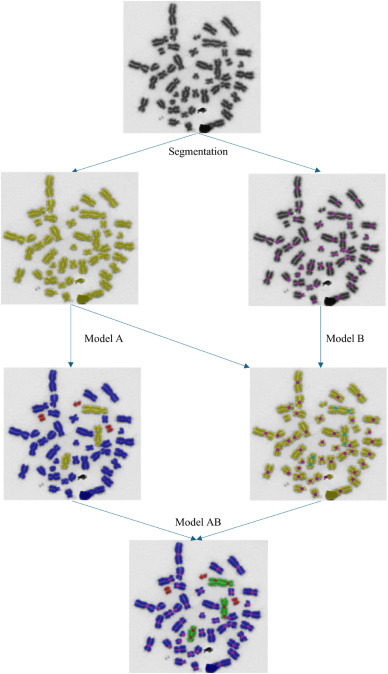
Image from article MaksChroms: An open-source CNN-based tool for dose prediction based on dicentric chromosome assay
What should be done if a nuclear disaster occurs or someone is exposed to harmful radiation – for example, as a result of a nuclear power plant accident, as in Ukraine? Doctors must then quickly determine the radiation dose the body has received, as this determines both the treatment method and the chances of recovery. A team of scientists from the Faculty of Physics of the University of Warsaw and the Faculty of Medicine of the University of Warsaw, collaborating with scientists from Germany and Japan, has developed innovative software that allows for a much faster assessment of the situation than before.
Most cells in our body contain chromosomes, which are condensed DNA. Normally, a chromosome has a single constriction in the center, called a centromere (a place resembling an indentation where two parts of a chromosome join). Sometimes, however, fragments of different chromosomes can fuse together, creating a structure with two centromeres, known as a dicentric chromosome.
Such changes occur, among other things, under the influence of ionizing radiation. The more dicentrics seen in the examined cells, the higher the radiation dose the body has most likely received. Traditionally, this is done manually – the laboratory technician must interpret what they see under the microscope.
Detecting radiation exposure may soon become much faster and easier. This is the result of the work of an interdepartmental team of researchers from the Faculty of Physics and the Faculty of Medicine at the University of Warsaw, who collaborated with scientists from Germany and Japan. The work was led by prof. Beata Brzozowska, professor at the Department of Biomedical Physics at the Institute of Experimental Physics. The scientists created MaksChroms – open-source and free diagnostic software based on convolutional neural networks.
MaksChroms’s authors
Maksymilian Głowacki is the lead author of the MaksChroms program – he worked on it first as a student as part of his bachelor’s thesis, and then completed it as a doctoral candidate at the Astronomical Observatory of the University of Warsaw, part of the Doctoral School of Exact and Natural Sciences.
Beata Brzozowska graduated in physics from the University of Warsaw, where she defended her doctorate in high-energy physics. She gained experience, among other things, in the international ZEUS experiment at the DESY center in Hamburg. She works in medical physics and radiobiology, studying the effects of ionizing radiation on cellular DNA. In her work, she combines laboratory experiments with advanced computer simulations to better understand the mechanisms of DNA damage formation and repair and its importance in cancer research, among other areas. One of the projects she coordinated was MaksChroms, which focused on biological dosimetry.
Józef Ginter earned a doctorate in physics in the field of neuroinformatics (“analysis of EEG signals during voluntary movement or its visualization”). Currently, he combines work at the Faculty of Medicine of the University of Warsaw and the Faculty of Physics of the University of Warsaw, dealing with the analysis of medical images and biological data using machine learning.
This text has been abridged and translated from the Faculty of Physics website; read more here (in Polish): https://www.fuw.edu.pl/aktualnosci-all/news10067.html
Article:
Maksymilian Głowacki, Martin Bucher, David Endesfelder, Maria Szoła, Adrianna Tartas, Yohei Fujishima, Ursula Oestreicher, Maria Kowalska, Paweł Kotowski, Jan Borkowski, Beata Pszczółkowska-Kępa, Józef Ginter, Andrzej Wojcik, Beata Brzozowska,
MaksChroms: An open-source CNN-based tool for dose prediction based on dicentric chromosome assay,
Radiation Physics and Chemistry,
Volume 239,
2026,
113329,
ISSN 0969-806X,
https://doi.org/10.1016/j.radphyschem.2025.113329.